
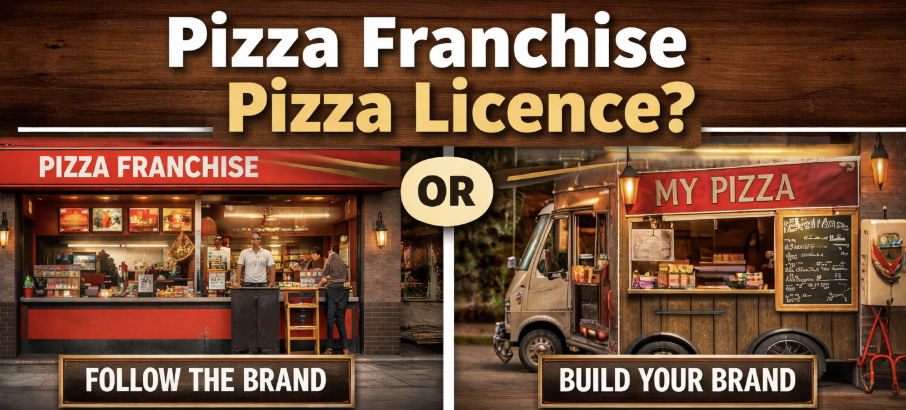
If you love making pizza and you’re serious about turning that passion into a business, this is one of the biggest questions you’ll wrestle with:
Should I pay for a pizza franchise, or get a pizza business licence and build my own brand?
It’s a fair question — and it’s one more people should ask before they spend a lot of money.
On the surface, both options can look similar. In both cases, you’re not starting completely from scratch. You’re buying into a proven way of doing things. You get guidance, systems, and a roadmap that’s meant to help you avoid costly mistakes.
But they’re not the same.
The choice really comes down to how much freedom you want, how much support you need, how much money you’re willing to invest, and what kind of business you actually want to build.
Let’s walk through it honestly.
What a pizza franchise gives you
When you buy a pizza franchise, you’re buying the right to operate under an established brand.
That usually means you get the name, the branding, the systems, the menu, the processes, and marketing support. In some cases, you’ll also get help with site selection, training, supplier relationships, and launch support.
For some people, that sounds ideal.
If you’re the kind of person who wants a clear playbook to follow, a franchise can feel safer. You’re not sitting there trying to invent a business model from scratch — you’re stepping into something that’s already been tested.
That can be especially appealing if your dream isn’t necessarily to create your own pizza brand, but simply to own and run a pizza business.
There’s real value in that.
A good franchise can save you time. It can reduce some guesswork. It can give customers instant recognition if the brand’s already known in your area. And if you’re someone who likes structure, rules, and a clear operating model, you may genuinely thrive in a franchise system.
But that support comes at a cost.
And not just financially.
What a pizza business licence gives you
A pizza business licence is different.
Instead of buying into someone else’s full brand, you’re buying access to a proven system, training, and know-how that helps you build your own pizza business.
That means you’re not locked into someone else’s name, identity, or exact way of doing everything. You get the blueprint, but the business still feels like yours.
For a lot of pizza makers, that’s a huge deal.
Because the truth is, many people who want to start a pizza business don’t just want to “operate a unit.” They want to build something personal. They want their own name on the van, trailer, pop-up, or shop. They want the freedom to shape the look, feel, and personality of the business around their own style.
A licence model can give you that.
You still get guidance. You still avoid a lot of painful trial and error. You still benefit from proven experience. But you’re building your own brand instead of renting someone else’s.
The money side matters more than people admit

Let’s be blunt: one of the first things buyers compare here is cost.
A franchise is often the more expensive route.
That doesn’t automatically make it bad. If the support, systems, and brand recognition are strong enough, some buyers will see that as money well spent.
But it does mean the bar is higher.
You need to be really clear on what you’re getting back for that investment.
A pizza business licence is often a lower-cost entry point. You’re usually paying for the system, training, and support without taking on the same level of ongoing brand-related fees and restrictions.
That can make a licence much more attractive if you want to start lean, stay flexible, and keep
If you’re working with limited funds — or you just don’t like the idea of paying ongoing fees for someone else’s brand — a licence may feel like the more sensible option.
If you’re trying to get your head around the numbers, it’s worth looking at a real breakdown of how much it actually costs to start a home pizza business with a licence, so you can compare the two properly.
Freedom vs structure

This is where the decision gets personal.
A franchise usually gives you more structure and less freedom.
That can be a good thing if you don’t want to make too many decisions. Maybe you want someone to tell you exactly how the menu should work, how things should be marketed, what the customer experience should look like, and what systems to follow.
Some people love that. It helps them move faster and feel more confident.
But for others, that same structure feels restrictive.
Maybe you want to experiment. Maybe you want to create your own brand identity. Maybe you want more say over the look of your business, the vibe, the messaging, or how you show up in your local area. In that case, a franchise can start to feel like a box.
A licence usually gives you more room to build the business your way.
That doesn’t mean no support — it just means you’re not giving up as much control in exchange for it.
For a lot of entrepreneurial people, that balance matters. They want help, but they don’t want to feel managed.
Which one is less risky?
A lot of buyers assume a franchise is always safer.
Sometimes that’s true. A recognised brand, a tested system, and ongoing support can reduce some of the risk — especially if you’re a first-time business owner.
But a franchise isn’t automatically a safe bet just because it’s a franchise.
If the fees are high, the location’s wrong, the margins are tight, or the franchisor’s support is weak, you can still struggle. Paying more doesn’t magically remove business risk.
A licence can be a smart, lower-risk option too — especially if it gives you the practical tools and support you need without loading you up with huge fixed costs.
In some cases, having lower overheads and more flexibility actually puts you in a stronger position.
So instead of asking, “Which one’s safer?” the better question is:
Which one fits me better?
Because what works for someone else might not work for you.
A licence can be a smart, lower-risk option too — especially if it gives you the practical tools and support you need without loading you up with huge fixed costs.
In some cases, having lower overheads and more flexibility actually puts you in a stronger position.
That said, every pizza business comes with its own challenges, whether you go franchise or independent — so it’s worth understanding the most common home pizza business problems (and how to avoid them) before you commit.
Who should consider a franchise?
A pizza franchise might be the better option if you:
- want to operate under an established brand
- prefer clear rules and systems
- like structure more than flexibility
- have the budget for higher upfront and ongoing costs
- don’t mind building someone else’s brand as part of the deal
There’s nothing wrong with that. For the right person, a franchise can be a great fit.
Who should consider a pizza business licence?
A pizza business licence might be the better option if you:
- want to build your own brand
- like the idea of support without heavy restrictions
- want more control over your business identity
- are looking for a lower-cost way to get started
- still want a proven roadmap instead of figuring it all out alone
For many passionate pizza makers, this is the sweet spot. You get expert guidance, but the business still feels like yours.
The real question underneath it all
When people ask,
“Should I pay for a pizza franchise, or get a pizza business licence and build my own brand?”
what they’re really asking is:
Do I want to follow a brand, or create one?
That’s the heart of it.
If your main goal is to own a pizza business with as much structure as possible, a franchise might be worth the higher cost.
But if your dream is to turn your love of pizza into something personal — something with your name, your story, and your identity behind it — then a licence may be the better path.
Neither option is automatically right or wrong.
The best choice is the one that matches your goals, your budget, your personality, and the kind of business you want to build.
Because at the end of the day, it’s not just about selling pizza.
It’s about building something you’ll still be proud of when the excitement of getting started wears off.
